KissyKat Games / CLAWDER / Wiki / Blocks & shapes
Blocks and shapes
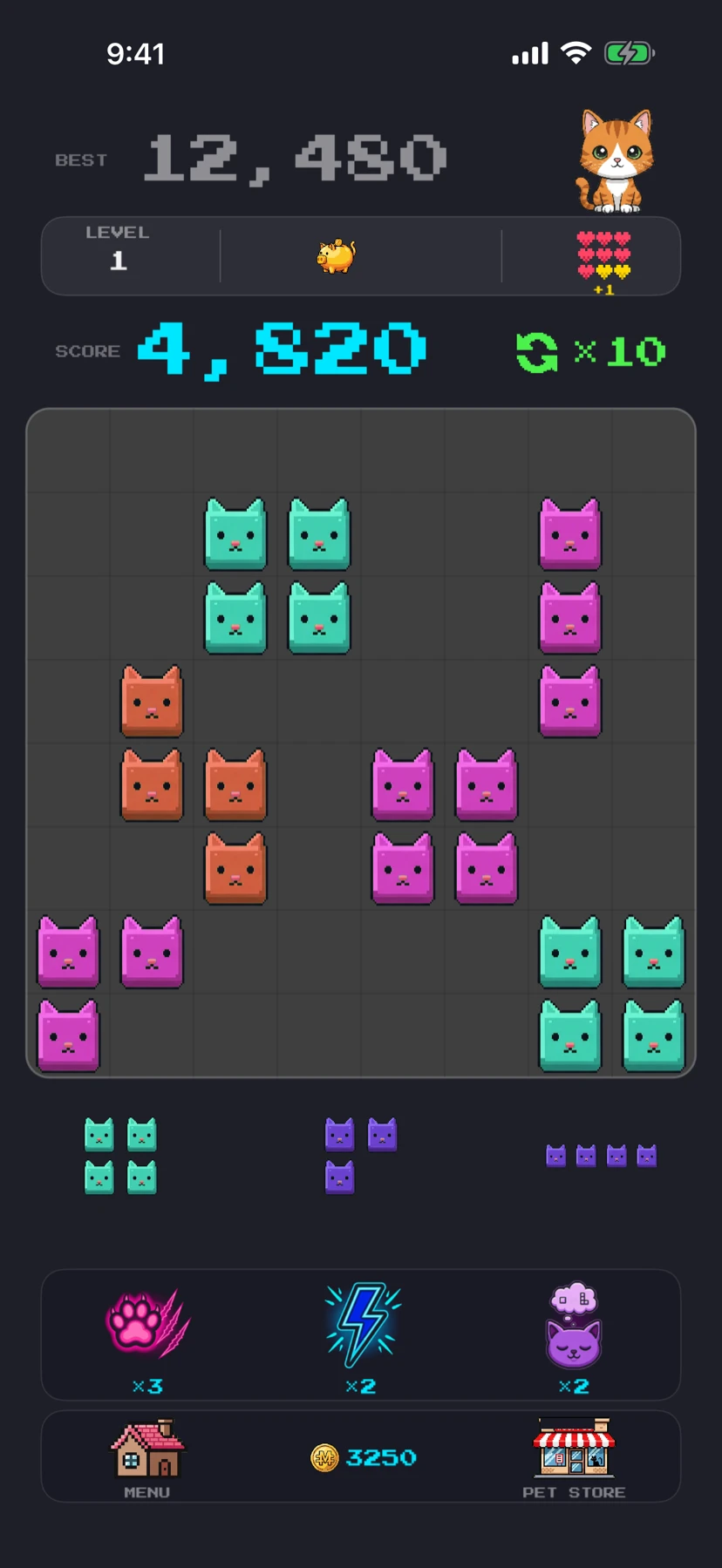
CLAWDER's pieces are cat-themed blocks. What matters for the score is the footprint: how many squares a piece covers, and whether those squares still exist on the board in front of you.
The families
Every piece in the tray belongs to one of four families. A piece lands only when its footprint matches open cells.
| Family | Footprint | Where it gets stranded |
|---|---|---|
| Single | One square. | Almost nowhere. It fills a gap and finishes a line. It will not rescue a board that needed a clear. |
| Line | Squares in a straight row, horizontal or vertical. | A line needs an unbroken run of empty cells the same length. One filled cell in that run blocks the whole piece. |
| Corner / L-shape | A bent run: a corner, or a longer L. | The bend needs two open edges at once. Filling a corner early removes the only home an L had. |
| 3×3 square | A solid three-by-three block, nine cells. | It needs a 3×3 pocket. On a crowded board, and on many Cat Mode cutouts, that pocket is the first thing to disappear. |
The 8×8 grid
The core board is eight cells by eight. A 3×3 can sit in the corner, against an edge, or in the middle, and an eight-cell line can lie along any full row or column that is still empty. Smaller lines and L-shapes fit in the gaps those big pieces leave behind.
The useful habit is the reverse of filling every edge. Keep at least one 3×3 pocket and one open corner until the tray proves you do not need them. A board that is "almost full" in a tidy way still dies the moment the next piece is the square that no longer fits. Placement order and line clears are covered in How to play.
Cat Mode cutouts
Cat Mode boards are the same idea with cells removed. The silhouette of the cat is the playable area. Cells outside it are not holes you can fill, and a row that runs into the cutout is shorter than the row on the plain 8×8.
That changes the families:
- A line that was safe on the rectangle may be longer than the open stretch inside an ear or a cheek.
- An L-shape needs its corner inside the silhouette. If the bend falls on a cutout, the piece has no legal drop.
- A 3×3 needs nine playable cells in a square. Cat Mode cutouts delete that pocket on purpose. Plan the 3×3 first on these boards, or assume you will need Scratch or Cat Nap when one shows up late.
Tray order
The tray is three pieces, not a queue you must play left to right. Name the largest footprint in the tray — usually the 3×3, otherwise the longest line or the L — and place the other pieces so that footprint still has a home. The small piece is the flexible one. Using it to plug the only 3×3 pocket is how a run ends with pieces still in the tray.
If every remaining piece is the wrong shape, that is what Cat Nap is for: a new tray of three. If one cell is the entire problem, that is Scratch. If a whole row has become a wall, that is Purr Power. You get charges through gameplay, and you can also recharge them with Meow Bucks. The longer score notes are in the high score guide.